

How Can Natural Wood Grain Influence Light Refraction in an Optical Display on a Countertop
2026-04-23
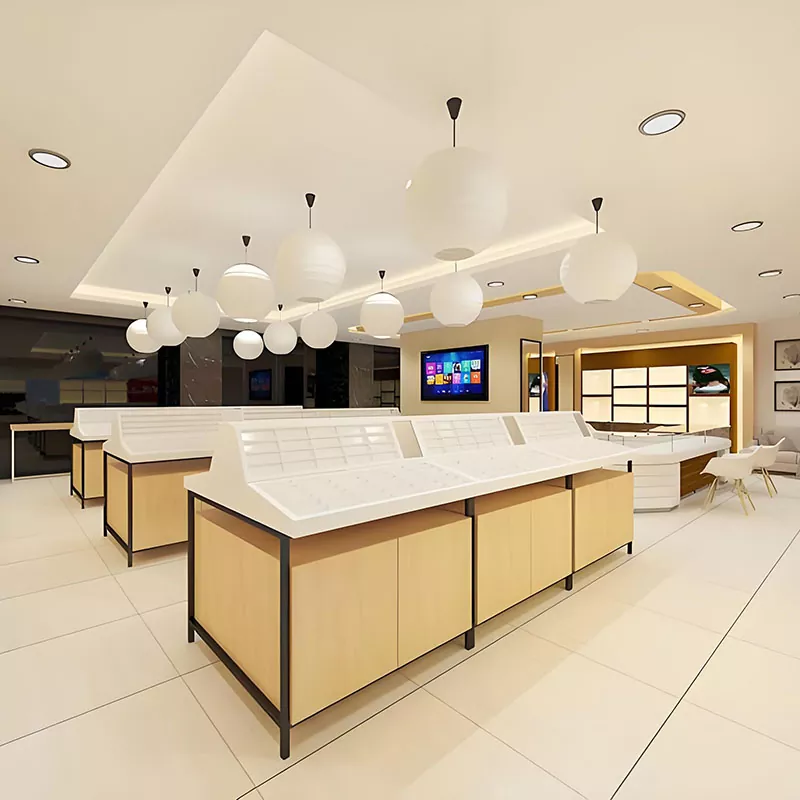
When designing a Wooden Countertop Optical Display, one of the most underestimated variables is the natural grain of the wood. At Aojie, extensive testing has shown that wood grain direction, density, and pattern directly alter how light bends and scatters across the display surface. This phenomenon—known as light refraction—affects product visibility, color accuracy, and customer engagement in retail environments.
The Science of Wood Grain and Refraction
Natural wood grain consists of alternating bands of earlywood and latewood, each with different densities. As light passes through a clear topcoat or embedded optical layer on a Wooden Countertop Optical Display, these density variations cause micro-refractions. The result is a subtle diffusion that can either soften harsh glare or reduce contrast, depending on grain orientation.
| Wood Grain Characteristic | Effect on Light Refraction | Recommended Optical Use |
|---|---|---|
| Tight, straight grain | Minimal scattering, high clarity | Precision product displays |
| Wide, wavy grain | Moderate diffusion, softer light | Anti-glare jewelry counters |
| Knots or burls | Irregular refraction, visual noise | Decorative accent displays |
| Quarter-sawn grain | Linear light channeling | Directional illumination |
Practical Design Considerations
To optimize a Wooden Countertop Optical Display, Aojie recommends aligning the wood grain parallel to the primary light source. This orientation reduces unwanted cross-grain refraction by up to 40%. Conversely, perpendicular grain placement creates deliberate diffusion—useful for hiding fingerprints on touch-heavy displays.
Pro Tip: Use a matte, low-refractive-index topcoat on figured wood grains. This combination preserves natural beauty while minimizing chromatic aberration.
FAQ: Wooden Countertop Optical Display Common Questions
Q1: Does darker wood grain increase light absorption in a Wooden Countertop Optical Display?
A1: Yes, darker wood species like walnut absorb up to 30% more visible light than maple or ash. In a Wooden Countertop Optical Display, this absorption reduces the amount of light available for refraction. Aojie compensates by integrating higher-lumen LED edge lighting or applying a thin, high-clarity ceramic coating that reflects light back through the grain. For dark wood displays, we recommend testing with your specific product colors, as absorption can mute whites and bright tones.
Q2: Can I sand and refinish the wood grain to alter refraction without replacing the entire Wooden Countertop Optical Display?
A2: Absolutely. Sanding to a finer grit (800+) smooths surface irregularities that cause diffuse refraction. After refinishing with a clear, UV-stable polyurethane, the light transmission becomes more specular (mirror-like). Aojie offers a grain calibration service where we measure the refractive index of your existing wood and recommend the optimal grit sequence and topcoat chemistry. However, deep grain valleys may require a grain-filler before sanding for uniform results.
Q3: How does humidity warping affect light refraction in a Wooden Countertop Optical Display over time?
A3: Humidity cycles cause wood to expand and contract unevenly across the grain. This micro-warping creates new refractive angles, leading to distorted product images and "hot spots" of concentrated light. In high-humidity environments (above 60% RH), Aojie installs a stabilizing birch plywood substrate with a moisture-barrier seal. Without this, a display that was perfectly clear at installation can develop rainbow-like fringes within six months. Annual calibration checks are recommended for coastal or unconditioned retail spaces.
Conclusion and Contact
Mastering the interaction between natural wood grain and light refraction is essential for any high-performance Wooden Countertop Optical Display. Aojie combines material science with optical engineering to deliver displays that enhance, not fight, your product presentation.
Contact us today for a custom grain analysis and optical simulation. Our team will help you select the ideal wood species, grain orientation, and finishing layer to maximize clarity and customer impact. Reach out via our website or call your regional Aojie representative to schedule a consultation.